FinCEN's New Residential Real Estate Reporting Rule Is Now in Effect
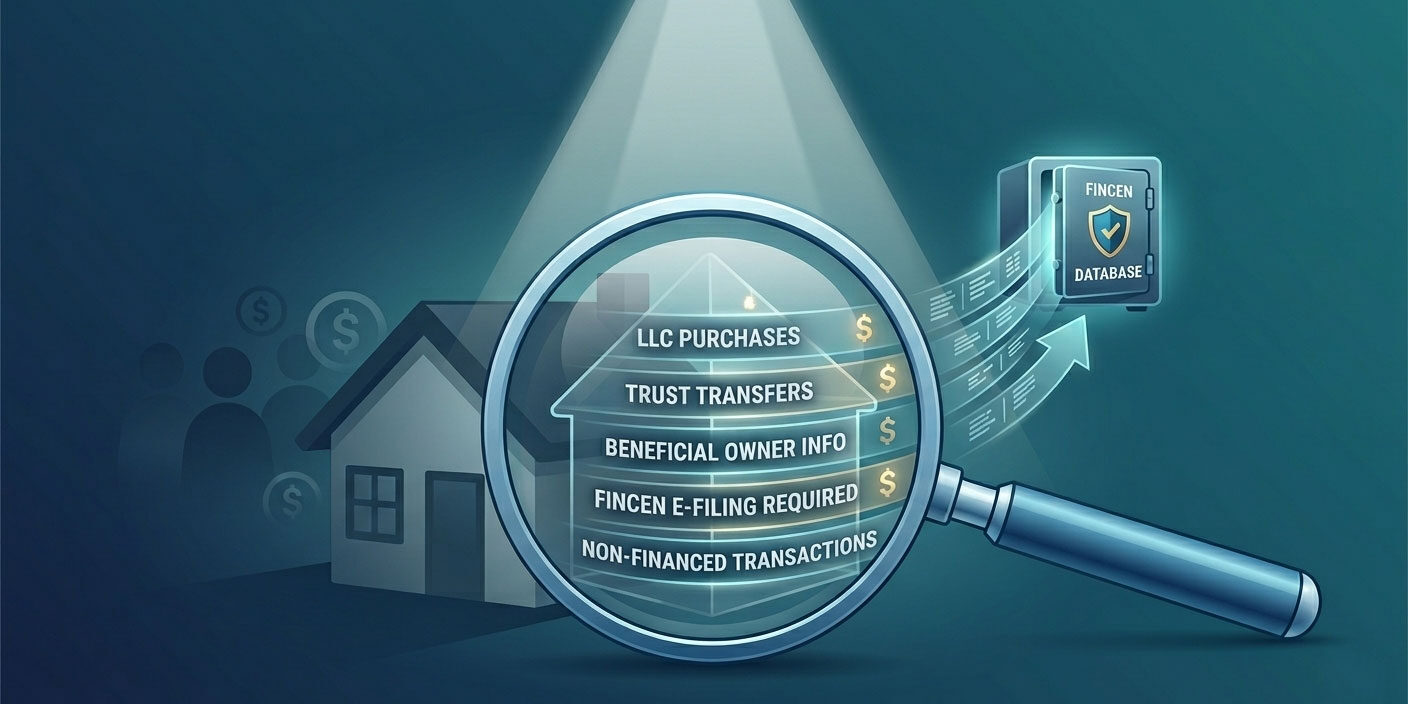
For the first time, federal law requires attorneys, settlement agents, and title companies to report the beneficial owners behind LLCs, trusts, and other entities that purchase homes with cash. Here's what everyone involved in a residential real estate transaction needs to know.
Rule is active now. The FinCEN Residential Real Estate Reporting Rule took effect on March 1, 2026. Transactions that closed on or after that date are subject to mandatory reporting. While litigation is ongoing in federal courts, no court order has stayed or paused the rule nationwide. Compliance is required today.
1 Background: Why the Government Is Watching Cash Real Estate Deals
Money laundering through U.S. real estate has long been a documented vulnerability. When a buyer obtains a mortgage, the lender regulated under the Bank Secrecy Act (BSA) must verify identities and file Suspicious Activity Reports (SARs) on unusual transactions. But when a buyer pays cash through an anonymous LLC or trust, those protections vanish entirely. No one checks. No one reports.
FinCEN addressed this partially through Geographic Targeting Orders (GTOs) starting in 2016, requiring title companies in select cities to report beneficial owners on high-value all-cash purchases. Those GTOs were limited to roughly 14 states and required minimum purchase thresholds. The new Final Rule replaces that patchwork permanently, with no geographic boundary and no dollar minimum.
There is no geographic limitation and no minimum purchase price. A $75,000 transfer of a residential lot to a family LLC is just as reportable as a $15 million Manhattan penthouse sold to an offshore trust.
2 What Transactions Must Be Reported?
A transaction is reportable when all three of the following conditions are met:
1. Residential property. The property must be located in the United States and qualify as residential, meaning single-family homes, townhouses, condominiums, cooperatives, or vacant/unimproved land where the buyer intends to build a one-to-four family structure.
2. Non-financed. The transfer must not involve a loan secured by the property from a BSA-regulated financial institution (bank, credit union, etc.). A loan from a private lender without BSA obligations is treated as a non-financed transaction and is covered.
3. Entity or trust transferee. At least one of the new owners must be a legal entity (LLC, corporation, partnership, estate) or a trust, domestic or foreign. Transfers solely to individuals in their personal names are not covered.
3 Key Exemptions
Not every entity/trust transfer triggers a report. The following transfers are explicitly exempt:
Additionally, 16 categories of highly regulated institutional entities are excluded as transferees: banks, government authorities, public utilities, securities reporting issuers, insurance companies, and their wholly-owned subsidiaries. Notably absent: private operating companies, accounting firms, and tax-exempt nonprofits, a significant difference from the Corporate Transparency Act.
4 Who Must File: The Reporting Cascade
Only one person files a report per transaction. The rule uses a seven-tier "reporting cascade" to assign that responsibility based on the function performed at closing. The first person in this hierarchy who participates in the transaction bears the obligation:
Parties within the cascade may use a written designation agreement to shift reporting responsibility to another cascade participant. Designation agreements must be transaction-specific, in writing, and retained for five years. They cannot be blanket agreements covering multiple transactions, and responsibility cannot be shifted to someone outside the cascade.
5 What Must Be Reported: Beneficial Ownership
The Real Estate Report form contains 111 data fields. The reporting person must collect and submit information about: their own identity, the property, the seller, the buyer entity or trust, the individuals signing closing documents on behalf of the buyer, and most importantly, the beneficial owners of the transferee entity or trust.
A beneficial owner is any individual who (a) owns or controls at least 25% of the entity's ownership interests, or (b) exercises "substantial control" over the entity, meaning senior officers, directors with significant authority, and anyone with meaningful influence over key decisions. For trusts, beneficial owners include the trustee, any person with authority to dispose of trust assets, the grantor if they retain revocation rights, and certain beneficiaries.
Required information for each beneficial owner includes: full legal name, date of birth, residential address, citizenship, and taxpayer identification number (or passport/foreign ID number for non-U.S. persons). The transferee must certify the accuracy of this information in writing. FinCEN Identifiers used under the Corporate Transparency Act are not accepted here.
Reports are filed electronically, free of charge, through FinCEN's BSA E-Filing System, the same platform used for other BSA reports. Three filing options are available: an online form, a PDF form, or an automated batch interface for high-volume filers.
What This Means for Attorneys and NorthStar's Clients
FinCEN carved out no exemption for attorneys. Lawyers who prepare deeds, handle closing escrow, provide title opinions, or manage any function in the reporting cascade are subject to the rule. This is especially significant in Washington State, where attorneys frequently serve closing functions.
For NorthStar clients and Washington practitioners, practical steps include:
- Updating client intake forms to capture beneficial ownership data before closing
- Registering with FinCEN's BSA E-Filing System now, before a reportable transaction arises
- Reviewing engagement letters to address data collection obligations
- Evaluating each entity/trust transfer for reportability and cascade position
- Using designation agreements proactively to allocate reporting responsibility in transactions with multiple closing professionals
- Training staff who handle closings and retaining certification documents for five years
6 Penalties for Non-Compliance
The RRE Rule is enforced under the BSA's existing penalty framework. Negligent violations carry civil penalties of up to approximately $1,394 per occurrence. A demonstrated pattern of negligent violations can result in penalties exceeding $108,000. Willful violations expose the reporting person to criminal liability: up to five years in prison and fines up to $250,000. There is no safe harbor for incomplete reports: FinCEN has made clear that filing a partial report is not permitted as a substitute for a complete one.
7 Current Status: Litigation and the Rule's Future
The rule faced challenges immediately upon taking effect. Fidelity National Financial filed suit arguing the rule exceeded FinCEN's statutory authority; a Florida federal court disagreed and granted summary judgment to FinCEN in early 2026, upholding the rule. A second case, Flowers Title Companies v. Bessent, remains pending in East Texas. A Puerto Rico privacy organization also filed suit days before the effective date, raising Fourth Amendment and constitutional commerce concerns.
The federal government delayed the rule's original December 2025 effective date to March 1, 2026, but then actively defended the rule in court, reflecting a commitment to combating foreign money laundering through real estate. Congressional Review Act resolutions introduced in 2025 did not advance. Unless a court issues a nationwide stay, the rule remains fully in effect and must be followed.
8 The Bottom Line
The FinCEN Residential Real Estate Reporting Rule is the most significant expansion of anti-money laundering obligations to touch the real estate industry in decades. It applies nationwide, regardless of transaction size, and it applies now. If you are involved in closings as an attorney, settlement agent, title professional, or escrow officer, you need a compliance system in place today.
NorthStar Law Group regularly advises clients on business compliance, international transactions, estate planning, and emerging regulatory requirements. If you have questions about whether your transactions are covered, how to structure a designation agreement, or how to build a reporting workflow that protects your practice, we are here to help.